#32 Barre for a Cause

One of the most rewarding aspects of this mitzvah project is that I am always, every day, on the lookout for mitzvot.  Fifty mitzvot are a lot, so I need to push myself to do things that I wouldn’t ordinarily do.  Like a Barre class.  I love my Tribe, but Barre isn’t really for me.  Lisa invited me to this class that her daughter Olivia put together to raise money for the Live Like Blaine Foundation.  The class was free, but they were collecting donations for the Foundation in memory of Blaine, a friend of Lisa’s family.  And I did it!  It was different, and challenging, and fun.  And I helped raise money while exercising – what could be better??


#31 Donate Clothing

I purged!!  I did the KonMari method of taking every single item out of my closet.  I held each one up and asked, “does this bring me joy?”  Turns out that there weren’t many pieces that brought me joy.  I got rid of about 50% of my closet – including the dress I wore to my rehearsal dinner, the nightgown that I wore on my honeymoon and other sentimental but outdated items.  This time, I put a lot of thought into where I wanted to donate these items.  I decided on Big Brother Big Sister.  Their mission aligns with my own, mentoring young people with your time and energy.  I felt good about my donation!


#30 Clean a Closet

My friend Jennifer knows that I love nothing more than cleaning and organizing closets!  She offered to help my meet my mitzvah goal by letting me into her closet – which I understand is very personal, and I feel honored to be trusted with this task.  We took every item out of Jen’s side and put the clothes into piles.  Only the items that she loves and looks great in went back inside.  She was able to get rid of three large garbage bags of clothes!  Now when she gets dressed each day, she knows that she has lots of great choices.  A win-win!


#29 Donate Blood

Rabbi Aryeh Leibowitz says, “The Gemara (Yevamos 79a) lists the three “signs”, or distinguishing characteristics, of the Jewish people: We are a merciful, bashful and kind people. Jews have distinguished themselves in America with great philanthropy and genuine concern for the welfare of the less fortunate. Our generosity is not limited to our willingness to give charity, but extends to giving of ourselves physically as well.” He concludes that, “giving blood, while not always obligatory is at a minimum, permissible, and more likely a very great mitzvah.” (http://www.torahmusings.com/2010/11/blood-donations-according-to-halacha/)

On Sunday, in Orlando, a crazed gunman entered Pulse, a gay nightclub, and gunned down the patrons, killing 49 people and injuring more than 50 others.  It was a the worst mass shooting in American history, in terms of numbers dead and injured.  The next day, there were lines of hundreds of people lining up to donate blood to the injured victims.  I was inspired.  I felt helpless, yet wanted to help.  I was too far away to do anything for the Orlando victims, but I could donate blood here in solidarity and memory of those who were killed.  I never gave blood before.  I was really nervous.  But I found a blood drive, drove there before I could change my mind, took deep breaths, and donated a pint of blood.  It felt great.  I think I’ll do it every 8 weeks, as recommended.  An easy mitzvah to add to my regular repertoire!


#28 Likboa Mezuzah: Affix a mezuzah to your doorpost

IMG_6898.JPG

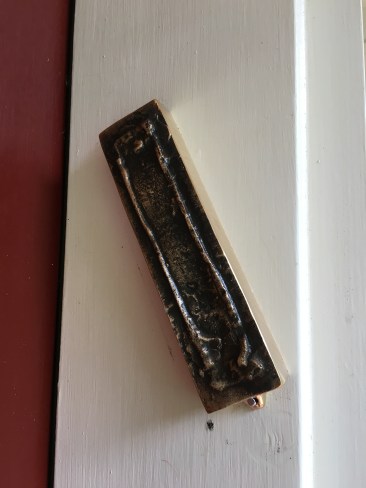
In the Torah, God has commanded us, “And you shall inscribe them on the doorposts of your home, and on your gates” (ibid., verse 9). Hence the mezuzah: a parchment scroll inscribed with the verses of the Shema prayer is affixed to the right doorpost of every room in a Jewish home.  The mezuzah is also a symbol of God’s watchful care. The name of God, Sha-dai, which appears on the reverse side of the parchment, is an acronym for the Hebrew words which mean “Guardian of the doorways of Israel.” Placing a mezuzah on the doors of a home or office protects the inhabitants—whether they are inside or out.

The mezuzah pictured above is a product of the project “Mezuzah From This Home” by the Judaica design brand Mi Polin (“From Poland”). The company was founded by a young Polish couple: Helena Czernek, 29, a designer, and Alexander Prugar, 30, a photojournalist.  Helena was a member of the Warsaw Moishe House, which our Jewish Federation Funds in part.  Mi Polin marks the first time Judaica objects are designed and produced in Poland after the Second World War.

According to the literature that came with my mezuzah, Poland had 3.5 million Jewish inhabitants before WWII.  In almost all of the Jewish homes, there was at least one mezuzah.  During the war, almost all of the Jews perished and the mezuzot are gone forever.  Only empty holes are left.  Helena and Alexander make molds of the holes and nails, the traces, where these mezuzot once lay.  These traces are witnesses for the Jewish inhabitants in Poland, an emptiness and symbol of those who passed away.

This particular mezuzah is from a tenement house at 8 Mostowa that was built sometime between 1868 and 1873 in Krakow.  The owner of the building was Abraham Lednitzer. He also had a prayer house built in 1907 in the backyard, which is now used as a workshop.  This bronze cast is from the mezuzah on the doorframe in apartments 18 and 19.  The Steiner family lived in apt. 19: Chasel Jakub (1894) and his wife Sheindel Matel (1898), and their children Fela (1918), Bronistawa (1921), Szaja (1923) and Pinkus (1930).  Records show that Fela and Szaja were transferred to a different apartment in 1941 and then sent to Lubicz camp.  Probably none of them survived.

Now I have the trace of their mezuzah on my front door.  I will remember them each time I enter my house.  Never forget.