#44 Pop-up Shop Stylist

In December, my family and I volunteered at Our Closet, sorting clothing that people had donated (Mitzvah #5).  Every week, Our Closet takes those sorted piles of clothing and sets up a pop-up clothing store that simulates a true shopping experience with tables, hanging racks, mirrors and a check out counter. The store is volunteer-run. There is no eligibility and customers are entitled to select up to 5 items free of charge. The store currently operates in partnership with community-based organizations throughout Philadelphia.

This pop-up shop was located at Casa Caribe, 173 W. Allegheny Ave, Philadelphia.  They had about 100 clients come through to shop, including mothers with babies and young children, mentally ill patients with their caseworkers, men of all ages and women who were picking up a few items to wear to work.  Besides setting up and breaking down the store, our job was to help the clients find their sizes, put together outfits that make them feel special and ooh and aah when they find the perfect piece.  I especially enjoyed helping this adorable 4 year old find a perfect Halloween costume, and a 2 year old choose a cute pair of boots!

#43 Sending Love!

img_8236What’s more fun than receiving a care package?  This Rosh Hashanah, I made sure that my loved ones knew that I was thinking of them and sending them sweet treats.  When I visited Ben, I brought a homemade round challah with apples and honey.  Then, I sent a package to Ethan with the same treats, plus granola bars for the days that he misses breakfast . . . and lunch.  Most days, I think.  I also sent a package to the family that hosted Maddie for 3 weekends in Israel – honey cakes and muffins.  Here’s to a sweet New Year!!

#41 Hillary!!!

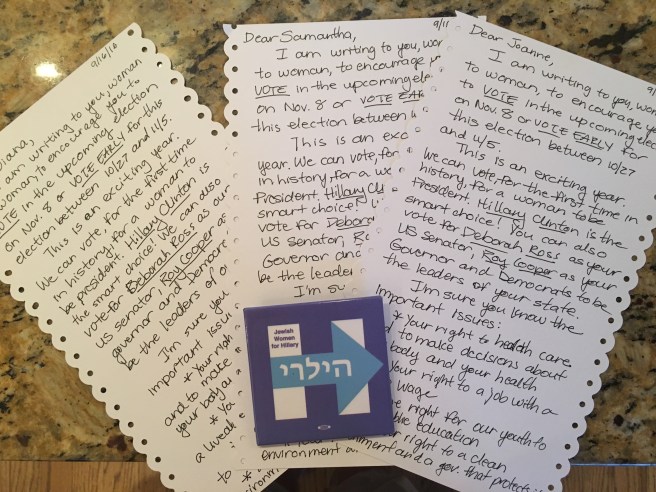
img_8063This is an exciting/crazy/frightening election year, so of course one of my mitzvot had to be related to the Democratic cause.  Thanks to my cousin Sharon, I was connected with  Durham Democratic Women,  an activist organization that focuses on issues that are critical to the well-being of Durham women and their families, within
our county, our state, and our nation.  Their website explains,  “25,000 Democratic women voters in Durham vote inconsistently, or not at all. Since 2008, Durham Women Vote has reached out to infrequent and new women voters through personal, handwritten letters and encouraged them to vote Democratic as the Democrats consistently support issues that are important to women. Studies show that the single biggest reason that women do not vote is that they think that their vote doesn’t matter. Other studies show that women listen to women. With a strong turnout of women voters, Durham can make the difference in the outcome of the election for all Statewide candidates.  Voters who received our letters in the past, turned out at significantly higher percentages than those who did not receive a letter.”

Out came the pen!  It’s actually hard to handwrite letters when you are just used to using a computer, where you can edit as you go along.  I really could have used some white out!  I utilized three different models from the website, combining and deleting to compose a meaningful letter.  I hope it makes a difference!  Otherwise, I may move to Canada .  .  .


#40 Eternity Blanket

img_7939

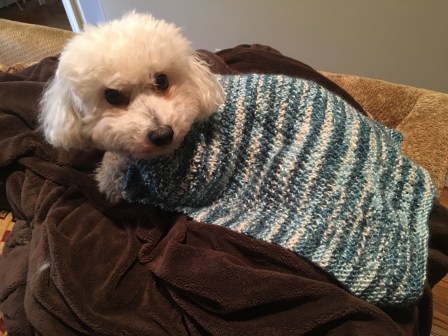
For this mitzvah, I worked for an organization that I discovered online called Knots of Love.  Knots of Love donates snuggly, soft blankets to Neonatal Intensive Care Units across the country. These hand-made gifts serve as a sign that each baby is loved and in the thoughts of caring people across the country.  According to their website, these blankets add, ” . . . color and warmth to an often stark Neonatal Intensive Care Unit. Parents sleep with the blankets before placing them on these precious new lives. By providing comfort to parents with babies in life-altering situations, often for months at a time, our blankets help make the experience a little less ‘clinical’ and provide a gift to cherish in the future. These treasures become a keepsake after the child is well and are sometimes put on display in shadow boxes or placed in a memory box.”

I haven’t knit in a long time, but I enjoy it so I decided to give it a try.  I followed the directions on the website exactly.  The blanket was supposed to be 18″ x 24″.  I have no idea what I did wrong, but my blanket was only 12 inches across.  I was so bummed because I put so much time and love into that blanket!  I called up the organization and spoke to a woman who could not have been nicer.  She told me that my blanket came out small for a reason — there is a real need for tiny blankets that can be given to babies who do not survive the NICU.  Parents like to have the babies buried in a blanket.  She asked if I was willing to donate one of these “Eternity” blankets.  I was touched.  Of course!  Even mistakes can have a purpose.  And now I’m at work on a much larger blanket, since it was a really enjoyable and meaningful mitzvah.

#39 Building a Library

Today I volunteered for an organization called WePAC (West Philadelphia Alliance for Children).  As a woman with a Doctorate in Reading/Writing/Literacy, this was right up my alley.  According to their website, WePAC offers two volunteer-driven programs, each designed to enhance literacy skills for young students:  School Library Opening/Staffing (read aloud to classes, engage students in literacy activities, catalog books, check them in and out, and maintain the library as a welcoming environment) and Library Buddies (working one-on-one with students on literacy skills through games, reading aloud, and activities, typically in the library setting, during literacy instruction time).

My mission today was to help build a library at the  Global Leadership Academy West (4601 W. Girard Avenue, Philadelphia).  Located in West Philadelphia, Global Leadership Academy serves approximately 700 students in kindergarten through eighth grade in a retrofitted industrial building.  They have been there for many years and they have a “library” but it was mainly used for students doing research on the computers.  None of the books on the shelves were being used!

Thus, enters WePAC.  Today’s goal was to continue categorizing all of the books.  I spent a few hours this afternoon putting stickers on the bindings and writing the type of book (E for Easy Reader) and the first three letters of the author, so the books can be shelved in alphabetical order.  There was also some weeding out, removing books that were old/torn/dated.  Next, the books will be shelved.  Then, they will have to come up with a system in which the kids can take books out and bring them home – hopefully this will be an electronic system!  Finally, WePAC will staff the library with volunteers.  They hope to have the library up and running by November.  This will be their 15th library that they are running.  What a great organization with an important mission!!


#42 Immerse in the Mikvah

img_8107The mikvah, or ritual bath, is one  of the most important cornerstones of the Jewish religion.  It is a “living water,” often collected rainwater.  Most Jews see the synagogue as the central institution in Jewish life, but Jewish law states that constructing a mikvah takes precedence even over building a house of worship. Both a synagogue and a Torah scroll, Judaism’s most venerated treasure, may be sold to raise funds for the building of a mikvah. In fact, in the eyes of Jewish law, a group of Jewish families living together do not attain the status of a community if they do not have a communal mikvah (http://www.chabad.org/theJewishWoman/article_cdo/aid/1541/jewish/The-Mikvah.htm)

Immersing in the mikvah, as part of the Laws of Family Purity,  is one of three classical women’s mitzvot. (The other two are lighting the Shabbat candles and separating some dough from the challah, Mitzvah #37).  This mitzvah for women is directly tied to the body cycle.  Traditionally, from the onset of menstruation and for seven days after its end, until the woman immerses in the mikvah, husband and wife may not engage in sexual relations. Immersion takes place after nightfall of the seventh day and is preceded by a requisite cleansing.  The woman bathes, shampoos, combs her hair and removes from her body anything that might impede her total immersion.  The immersion is valid only when the waters of the mikvah envelop each and every part of the body and, indeed, each hair, and there is a “mikvah lady” present to make sure that each of the three dunks is “kosher.”

Today, there are many reasons for visiting a mikvah besides the purification after menstruation.  Entering the mikvah is often seen as a spiritual separation, changing from one spiritual state to another.  People who are being converted dunk, women dunk before they get married or even after a divorce or illness, people dunk before major life milestones such as a Bar/Bat Mitzvah or a 50th birthday (!), and even silverware can be dunked to make it kosher.

I went to the mikvah as part of my preparation for turning 50.  For me, it’s a spiritual practice, connecting me to my foremothers before me and my daughters and granddaugters who will come after me.  It’s one of only three mitzvot that are ascribed to women, and thought I don’t follow the Laws of Family Purity, I respect their origins in the Torah.  And as a bonus, my mitzvah lady was one of my closest friends, and that made it even more special.
#38 G’milut Chasadim: Acts of Loving Kindness, Donating Challah


We belong to Congregation Beth Am Israel. One of the things I love about my synagogue is that at the heart of Beth Am Israel’s values is a commitment to tikkun olam, repairing the world. There is a wonderful G’milut Chasadim committee, responsible for providing meals for families who have illnesses or are in mourning.  As a result of my Challah Baking Class, I had MANY extra challot!!  I packaged them up and brought them to the G’milut Chasadim freezer at Beth Am.  Hopefully the recipients will be just as happy receiving these challot as I was making them!


#37 Hafrashat Challah: Separating the Challah, or “Challah Class”

The first portion of your kneading, you shall separate as a dough offering (challah) . . . In all your generations, give the first of your kneading as an elevated gift to G‑d. (Numbers 15:20–21)

When the Jewish people first entered and settled the Land of Israel, one of the gifts they were commanded to give to the kohanim, the priestly tribe, was challah—a portion of dough separated from their kneading bowl every time they baked bread.  Today, we do not actually give the challah to the kohen. However, we still observe the mitzvah by burning the challah portion, as its sacredness prohibits us from using it (http://www.chabad.org/theJewishWoman/article_cdo/aid/2689640/jewish/Womens-Special-Mitzvot.htm).

The mitzvah of separating challah is one of the special mitzvot entrusted to the Jewish woman, who is so influential in shaping the values and attitudes of her family.  I really connect with the idea that baking challah is like raising children.  They won’t “rise” like the yeast unless there is a lot of “sugar” added (praise, joy, laughter and fun).  After you add the sugar, you can add a pinch of salt (criticism, discipline, seriousness).  Notice that there is a lot more sugar than salt, but both are critical in balance.  Next, you knead the dough, pulling and pushing and shaping.  And then you leave it alone!!  You’ve already put in the right ingredients and shaped it with your hands – time to let them learn, develop and grow on their own.  Every blob of dough is different, even when I use the same ingredients.  Sometimes it rises easily, other times it takes longer to rise, or it rises and falls and rises again — just like children.  Finally, you separate the dough, remembering that it’s really out of your hands and into G-d’s hand, and with this sanctification you have completed the mitzvah of Hafrashat Challah.

For this mitzvah, I taught my girlfriends how to bake challah.  There was a huge interest, and I ended up teaching three separate classes to a total of 16 friends.  We had fun getting messy and learning a bit of Torah in the process.  And if each of these women teaches it to her daughters, the tradition will continue through the generations.  How rewarding!